

VikingCloud News & Resources
Check out the latest news and resources from VikingCloud.
Explore all Resources
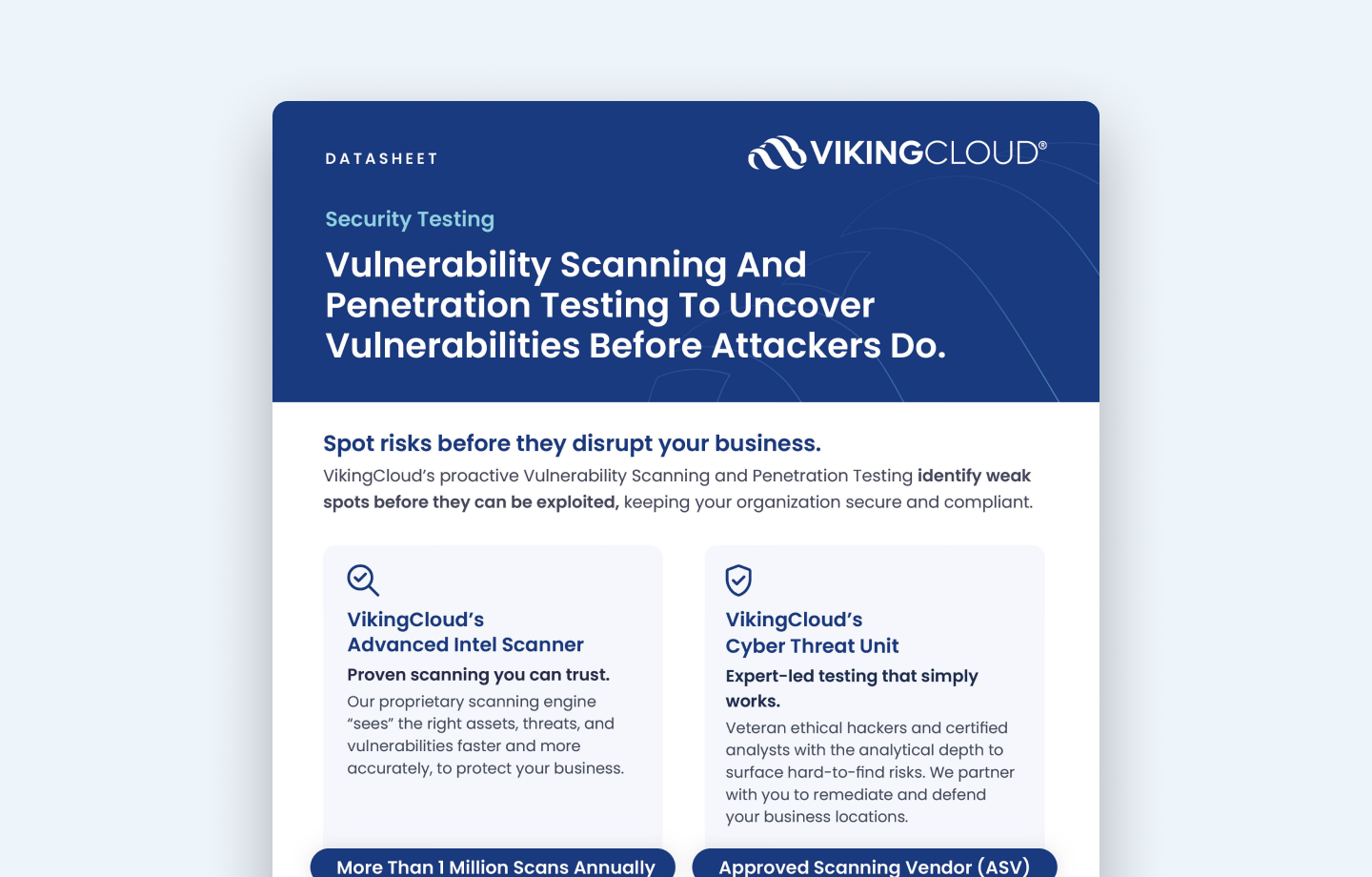
Our Cyber Threat Unit hunts the way attackers do, using proprietary frameworks and advanced technology to find your weak spots first.

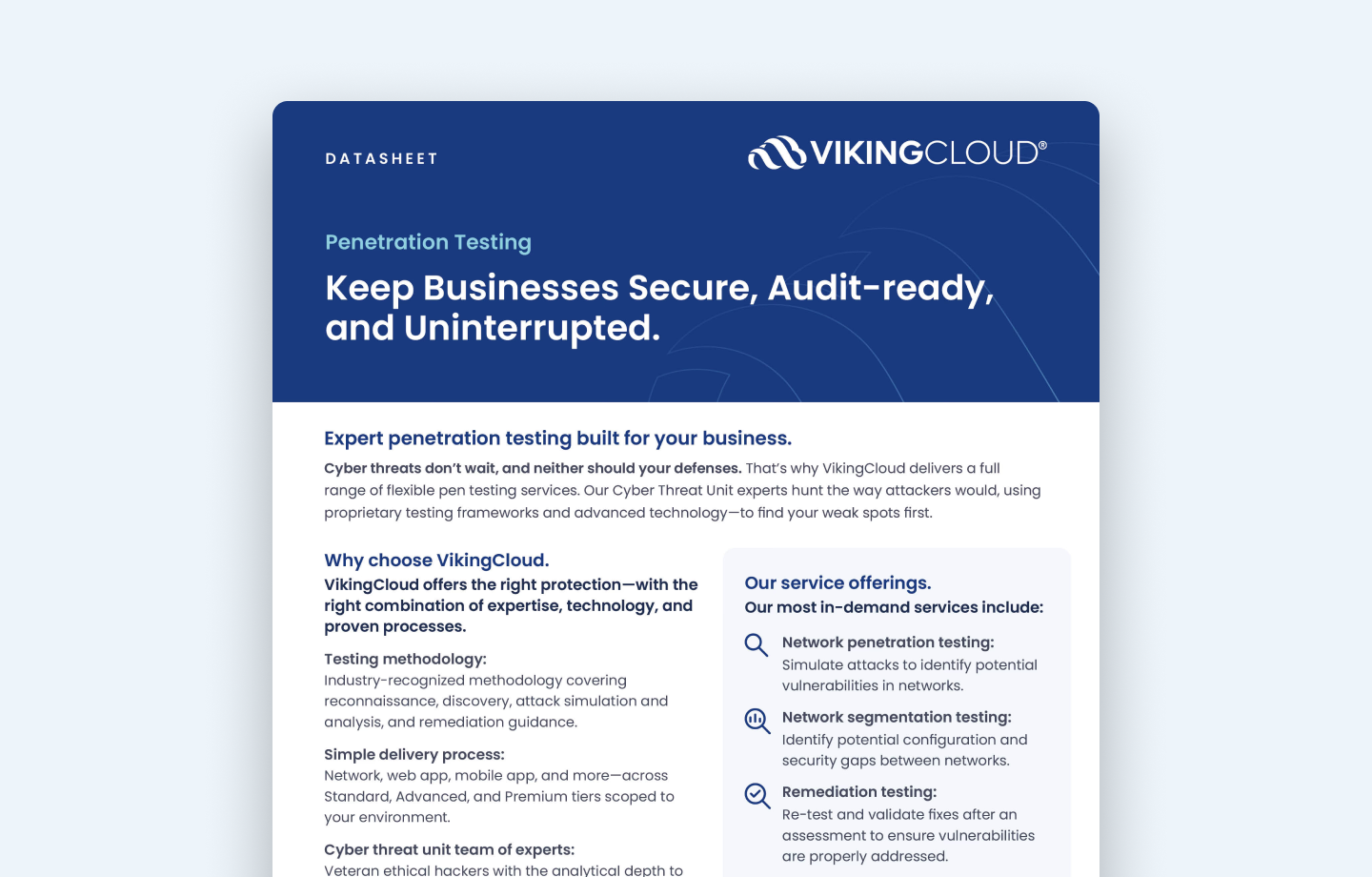
Cyber threats don’t wait, and neither should your defenses. That’s why VikingCloud delivers a full range of flexible pen testing services designed to uncover vulnerabilities before attackers do. Our most in‑demand pen testing services include:
Network Penetration Testing
Exposes both internal and external networks to hacking tactics, techniques, and protocols to identify potential unknown entry points and gaps in internal data protection safeguards across OS, firewalls, and Wi-Fi.
External penetration testing gives you a real-world snapshot of your cyber resilience, revealing strengths, exposing weaknesses, and showing exactly where your defenses need to advance.
Internal penetration testing safely stress tests your environment from the inside, uncovering hidden vulnerabilities, risky behaviors, and internal weaknesses that attackers could exploit to reach your network and sensitive data.
Network segmentation testing verifies whether your isolation controls—firewalls, VLANs, and ACLs—properly block unauthorized traffic between network segments.
PCI penetration testing uncovers security gaps that could expose cardholder data, giving you a clear path to strengthen your defenses and maintain compliance with confidence.
Red Teaming covertly simulates real attackers to test detection and response, while Purple Teaming uses open collaboration to strengthen defenses in real time.
Wireless penetration testing evaluates the security of your wireless networks and connected devices to uncover vulnerabilities.
Application Penetration Testing
Simulates real-world external cyberattacks to identify vulnerabilities in clients’ web and mobile applications.
An In-Depth Overview API penetration testing probes the interfaces connecting your applications and services for vulnerabilities that attackers could exploit, to access sensitive data or disrupt operations.
Key Insights for Security Web application penetration testing simulates real attacker techniques to identify weaknesses in your public-facing apps and software.
Mobile app penetration testing uncovers vulnerabilities before attackers can exploit them, helping you protect user data, maintain trust, and stay compliant.
Exposure Testing
Identify where your organization’s attack surface is exposed by testing cloud environments, web and mobile applications, personnel, physical security controls, and credentials for signs of compromise.
Automated penetration testing uses software-driven attack simulations to rapidly scan networks and infrastructure for vulnerabilities, delivering faster, repeatable results at scale.
Cloud penetration testing identifies vulnerabilities across your cloud environment—from shared infrastructure to the third-party apps and services that support it.
Credential Compromise Assessment
A credential compromise assessment proactively checks whether user credentials—like usernames, passwords, or API keys—have been stolen, leaked, or misused by unauthorized parties.
Mobile Application Scanning
Mobile Application Security Testing (MAST) identifies security vulnerabilities in mobile apps to protect sensitive data, prevent attacks, and support regulatory compliance.
Physical penetration testing identifies security weaknesses across your facilities and onsite controls, helping you understand where your physical defenses are vulnerable.
Social Engineering Penetration Testing
Social engineering penetration testing simulates real-world scams to reveal how easily employees can be manipulated and where human layer defenses need strengthening.
Vulnerability Research
Vulnerability research is the systematic process of identifying, analyzing, and reporting security flaws in software, hardware, and networks to prevent exploitation.
Web Application Scanning
Web application scanning automatically tests websites and web apps for vulnerabilities using DAST-style attack simulations to find weaknesses before they’re exploited.
Application Penetration Testing
Simulates real-world external cyberattacks to identify vulnerabilities in clients’ web and mobile applications.
An In-Depth Overview API penetration testing probes the interfaces connecting your applications and services for vulnerabilities that attackers could exploit, to access sensitive data or disrupt operations.
Key Insights for Security Web application penetration testing simulates real attacker techniques to identify weaknesses in your public-facing apps and software.
Mobile app penetration testing uncovers vulnerabilities before attackers can exploit them, helping you protect user data, maintain trust, and stay compliant.
Network Penetration Testing
Exposes both internal and external networks to hacking tactics, techniques, and protocols to identify potential unknown entry points and gaps in internal data protection safeguards across OS, firewalls, and Wi-Fi.
External penetration testing gives you a real-world snapshot of your cyber resilience, revealing strengths, exposing weaknesses, and showing exactly where your defenses need to advance.
Internal penetration testing safely stress tests your environment from the inside, uncovering hidden vulnerabilities, risky behaviors, and internal weaknesses that attackers could exploit to reach your network and sensitive data.
Network segmentation testing verifies whether your isolation controls—firewalls, VLANs, and ACLs—properly block unauthorized traffic between network segments.
PCI penetration testing uncovers security gaps that could expose cardholder data, giving you a clear path to strengthen your defenses and maintain compliance with confidence.
Red Teaming covertly simulates real attackers to test detection and response, while Purple Teaming uses open collaboration to strengthen defenses in real time.
Wireless penetration testing evaluates the security of your wireless networks and connected devices to uncover vulnerabilities.
Exposure Testing
Identify where your organization’s attack surface is exposed by testing cloud environments, web and mobile applications, personnel, physical security controls, and credentials for signs of compromise.
Automated penetration testing uses software-driven attack simulations to rapidly scan networks and infrastructure for vulnerabilities, delivering faster, repeatable results at scale.
Cloud penetration testing identifies vulnerabilities across your cloud environment—from shared infrastructure to the third-party apps and services that support it.
Credential Compromise Assessment
A credential compromise assessment proactively checks whether user credentials—like usernames, passwords, or API keys—have been stolen, leaked, or misused by unauthorized parties.
Mobile Application Scanning
Mobile Application Security Testing (MAST) identifies security vulnerabilities in mobile apps to protect sensitive data, prevent attacks, and support regulatory compliance.
Physical penetration testing identifies security weaknesses across your facilities and onsite controls, helping you understand where your physical defenses are vulnerable.
Social Engineering Penetration Testing
Social engineering penetration testing simulates real-world scams to reveal how easily employees can be manipulated and where human layer defenses need strengthening.
Vulnerability Research
Vulnerability research is the systematic process of identifying, analyzing, and reporting security flaws in software, hardware, and networks to prevent exploitation.
Web Application Scanning
Web application scanning automatically tests websites and web apps for vulnerabilities using DAST-style attack simulations to find weaknesses before they’re exploited.


VikingCloud's Cyber Threat Unit is built around certified ethical hackers who think like attackers and work for you, grounded in industry-recognized frameworks. Our testers span three continents and bring credentials that translate to real-world attack scenarios.

Ensures testers are skilled in real-world attack scenarios.
Trains experts to simulate advanced, persistent threats traditional tests may miss.
Showcases proficiency in network and web app exploitation.
Equips individuals with the knowledge to think and act like a hacker.
Ensures testers have a deep understanding of security and risk management.
Maintains cutting-edge knowledge of the latest threats and attack vectors.





VikingCloud’s Asgard Platform puts pen testing and compliance in one secure hub.
Stay aligned, stay protected—without adding extra work.
%201.png)
Get more details on VikingCloud’s suite of cybersecurity and compliance services.
Case Studies
Read our case studies to find out how VikingCloud helps businesses across diverse industries to overcome cybersecurity and compliance challenges.
Our case studies showcase real-world success, where proactive protection meets seamless operations, keeping businesses secure, compliant, and uninterrupted.

Annual penetration testing: Now a proposed HIPAA requirement.
Proposed updates to the HIPAA Security Rule would require covered entities and business associates to conduct penetration testing at least once every 12 months, performed by qualified personnel with knowledge of accepted cybersecurity principles.
The rule is targeted for finalization in May 2026. If you don't have annual pen testing in place, now is the time to start.
Connect with us.
VikingCloud's Cyber Threat Unit conducts network and application penetration testing with the depth, documentation, and expert-led remediation guidance your HIPAA compliance program demands. Our testers hold industry-leading certifications, and our findings reports are built for both technical and compliance audiences.
.png)
VikingCloud’s experts put your security to the test by validating controls, uncovering vulnerabilities, and hardening your defenses.
From phishing simulations and credential compromise assessments to black box and cloud penetration testing, we deliver comprehensive vulnerability management that keeps your business resilient and uninterrupted. Our key guidelines include:
Open Source Security Testing Methodology Manual (OSSTMM)
National Institute of Standards and Technology (NIST) Special Publication 800-115: Technical Guide to Information Security Testing and Assessment
Penetration Testing Execution Standard (PTES)
Open Web Application Security Project (OWASP) Testing Guide
Council of Registered Ethical Security Testers (CREST) Accreditation Pathway
Our methodology supports compliance reporting for PCI DSS, HIPAA, SOC 2, and ISO 27001, with reporting designed for technical, compliance, and executive stakeholders.
Here are common questions we are asked about our Pen Testing Services. For additional terminology and information, check out our Cybersecurity Glossary.
Penetration testing services simulate cyberattacks to identify security weaknesses, offering actionable insights that help organizations understand and remediate vulnerabilities, strengthening their security posture.
Penetration test costs vary widely, typically ranging from $5,000 to over $100,000, depending on factors like scope, complexity, and the expertise of the testing team.
The three main types are:
Penetration testing helps organizations meet compliance requirements across PCI DSS, HIPAA, and other frameworks by identifying and addressing security gaps before they can be exploited. Beyond satisfying a checkbox, regular pen testing demonstrates a security posture that regulators and auditors expect to see. Under the proposed HIPAA Security Rule updates, it will be an explicit annual requirement for every covered entity and business associate.
Advanced threat simulations mimic sophisticated attacks like ransomware, phishing, and credential harvesting exploits to evaluate an organization's detection and response capabilities against real-world threat.
Comprehensive services encompass:
Red Teams simulate attackers; Blue Teams defend. Purple Team assessments foster collaboration between both, enhancing overall security by identifying and mitigating vulnerabilities more effectively.
Penetration testing services can be tailored in scope and depth, allowing organizations to prioritize critical assets and scale assessments according to their specific risk management requirements.
Vulnerability scanning identifies potential weaknesses using automated tools; penetration testing involves manual, in-depth exploitation of vulnerabilities. Together, they provide a comprehensive security assessment.
Organizations should conduct penetration testing at least annually and after significant changes to the IT environment to maintain robust security against evolving threats.
Yes. VikingCloud is recognized on the CREST Accreditation Pathway. Your auditors and procurement teams get independent confirmation that our penetration testing aligns with a trusted global standard.
The Council of Registered Ethical Security Testers (CREST) is the global benchmark body for cybersecurity testing. As a Pathway organization, we’ve signed CREST’s Codes of Conduct and Ethics, committed to its testing standards, and are progressing toward full CREST Membership.
Check out the latest news and resources from VikingCloud.
Get started with a VikingCloud cybersecurity and compliance assessment with our cybersecurity experts.
A CREST Pathway organization has signed Codes of Conduct and Ethics and committed to CREST’s standards. A CREST Pathway organization is aiming for, but is not, a CREST Accredited member company.